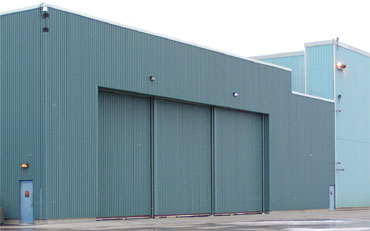
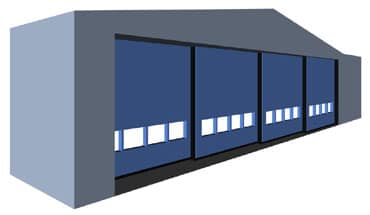
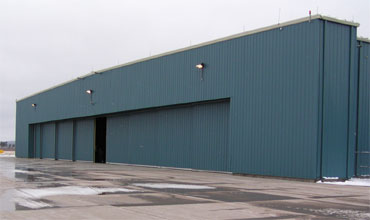
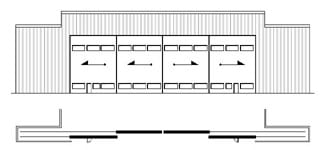
Three approaches to the way bottom-rolling hangar doors open offer different workflow features. Slide-to-One-Side, Bi-parting, and Multidirectional each have distinct application and cost profiles.
Slide-to-One-Side
Slide-to-One-Side hangar doors require only one panel or blade to be powered. As it moves, it picks up each consecutive blade until all are moved to one side. Side room is required on only one side to house the blades when the door is open. As each blade is picked up, the total weight to be moved increases, so it is not recommended to use a Slide-to-One-Side door when there are more than five blades.
Application: As the door opens from the left or right side rather than the centre, it is not recommended to use this type of door with tail fin or fuselage openings.
Cost: As only one blade has a motor and requires power, the initial costs and maintenance costs are lower. The control panel is also simplified, so overall, this is the lowest cost design.
Bi-parting
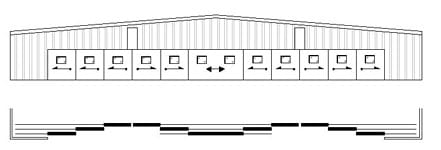
Bi-parting hangar doors part in the centre with half the blades moving to the left and the other half moving to the right. Side room is required on both sides to house the blades when the doors are open. No more than eight door sections are recommended, giving a recommended maximum of four blades on each side.
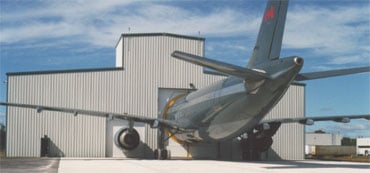
Application: Due to the centre-parting of the doors, these are ideal for use where a tailfin or fuselage opening is required.
Cost: The costs are higher for this type of door than for a Slide-To-One-Side door as a Bi-parting hangar door is essentially two Slide-To-One-Side doors. The two centre panels are motorized and both require power. However, the controls remain simple.
Multidirectional
Multidirectional hangar doors allow each door panel or blade to move independently. This gives maximum flexibility and means that side room is not required. However, with no side room, the door cannot open to 100% of the width of the opening. With this type of door, the number of panels is unlimited as each panel has its own motor and power supply.
Application: This design allows for the highest level of flexibility. Individual bays can be individually accessed across the span, without opening the entire door.
Cost: This makes the multidirectional hangar door the highest cost design solution with the highest maintenance cost. It also leads to more complex controls to allow each blade to be positioned independently.
At Spec-Dor, we bring rigorous engineering to custom hangar door requirements We’re here to meet your needs. It’s at the heart of our engineering approach: Use Case Driven Design!
Spec-Dor Aircraft Hangar Doors
Typically replies within 12 to 24 hours
Are there any questions you have? How may we assist you?